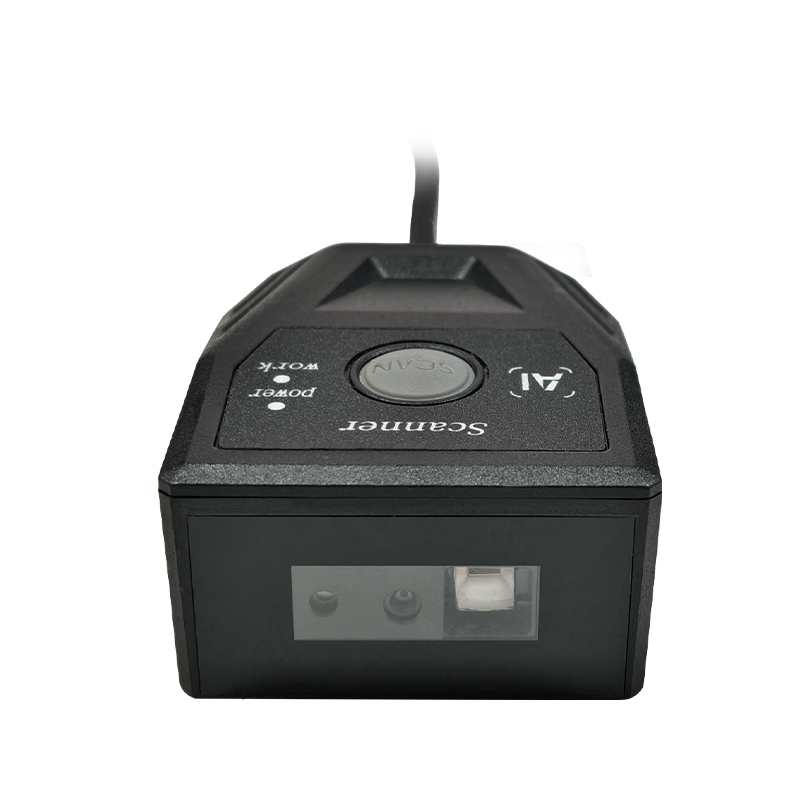
Barcode Scanners for Industrial Equipment & Automation
Build identification into production stations and automated equipment. Define reading geometry, triggering and host communication before choosing a scanner.
Barcode Scanners for Industrial Equipment & Automation — integration layout.
Control the reading geometry
Record barcode position, orientation and the range of part sizes. For moving items, include line speed and the time the code remains in view. Test the smallest and most difficult code at the actual working distance; a stationary sample does not establish performance on a moving line.
Coordinate the trigger and data flow
Determine whether a sensor, controller or application initiates reading. Confirm the selected scanner supports the intended trigger arrangement and data output. Specify how the host identifies a no-read condition and associates each decoded value with the correct part.
Assess the environment as a system
Ambient light, vibration, enclosure design and cable routing may affect the installation. Compare the exact product’s environmental limits against the operating conditions. Where additional protection is needed, evaluate the complete enclosure rather than the scanner alone.
Build a representative acceptance test
Test normal operation alongside failure scenarios: an absent code, a damaged label, two codes in view and a disconnected host. Confirm recovery after power cycling. Agree on project acceptance criteria using the actual equipment, labels and operating conditions.
BUILD YOUR PROJECT BRIEF
What to confirm before selection
Code size, position and motion
Reading distance and available exposure time
Trigger source and host interface
Environmental and enclosure requirements
No-read response and recovery behavior
Can I use a fixed-mount scanner on a moving line?
Suitability depends on speed, code size, lighting, field of view and the model. Provide motion and label samples for evaluation.
Are all industrial code types supported?
No. Confirm each required symbology and any special marking method for the chosen model. Do not assume direct-part-mark reading is included.
EXPLORE YOUR HARDWARE OPTIONS
Fixed-Mount Barcode Scanners for OEM Integration
Compare model specifications and share your application requirements to confirm the right configuration.
An interface choice affects wiring, software and integration effort. Compare the host’s electrical requirements and expected data flow before selecting a scanner configuration.
Reading distance is a relationship between the barcode, optics and environment. Evaluate the working range using the labels and installation that matter to your project.
Use a structured sample evaluation to reduce surprises between prototype and production. Bring optical, electrical, mechanical and software checks into one project record.